Lower operating costs – greater sustainability
Flat glass processor saves 5.5 million liters of fresh water per month
Our customer:
Precision Glass Industries (PGI) in Houston is a rapidly growing manufacturer of flat glass products for the architectural sector. PGI offers high-quality, custom-made glass solutions, from perfectly fitted shower enclosures and insulated glass for commercial applications to laminated glass and architectural glass elements, including railings, partitions, and facades. Founded in 2017, the company places great emphasis on technological innovation and sustainability.

The Challenge
With the increasing expansion of production and the acquisition of more and more processing machines, a reliable system for cleaning and reusing grinding water for edge and CNC machining became a pressing issue for PGI. Fresh and wastewater costs rose to over USD 100,000 in 2020, and a major consumer and polluter was edge and CNC machining, which required large quantities of water for cooling and rinsing the grinding tools. Grinding sludge amounted to approximately 700 kg of glass sludge per day, which had to be shoveled out of the machines' water tanks or mined out daily, or at least weekly. Meanwhile, the machine downtime caused by cleaning operations was hindering further increases in production output.
Furthermore, the need for exceptionally clean water for the internal tool cooling of the growing fleet of CNC machines was increasing: This so-called spindle water flows through sensitive rotary unions, where even microscopic particles can cause wear and premature spindle failures. The previously used chemical grinding water treatment system with flocculants had become overloaded and was out of service, as its narrow operating limits meant it could no longer cope with the growing volumes of wastewater from the ever-expanding range of machining centers and washing systems.
In search of a sustainable, robust and future-proof solution, PGI contacted STA at the end of 2020.
Privacy Policy
The Solution
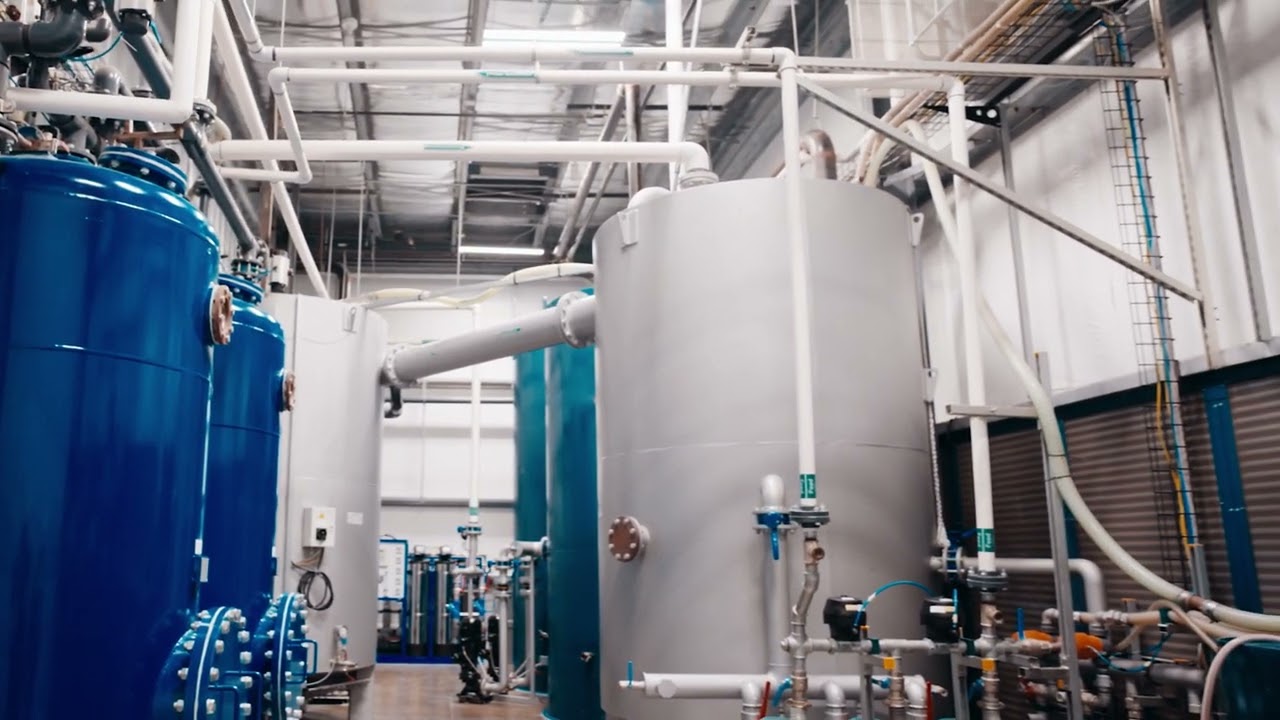
In 2023, STA developed a central water recirculation system for the Texas-based glass processor. Two years later, the system was expanded and now recycles 2,300 liters of grinding water per minute. In addition, 600 liters of ultrapure, microfiltered water per minute are processed for CNC machining.
This is made possible by the innovative combination of centrifugal separators and regenerable sand filters. The centrifugal separators remove 90% of the grinding swarf, including particles down to 2–3 μm in size, from the grinding water. The downstream sand filter stage filters the pre-cleaned water to 99.5% purity. During automatic filter regeneration, the backwash material is fed back into the centrifuges. This creates a single, central disposal point, and the separated sludge is compact and dry. As a result, the disposal volume is reduced by up to 80% compared to the previously used flocculation system.
Key features of the closed-loop system include a pressure-controlled process supply via frequency converter pumps, cyclone tanks for particle concentration, and continuous monitoring of water purity using turbidity sensors. The PLC control system allows for continuous monitoring of all relevant process and system parameters, as well as remote maintenance access by STA in Germany.
Advantages
PGI now operates one of the most advanced water purification systems in its industry across North America. This significantly reduces operating costs: With the STA system, PGI saves more than 5.5 million liters of fresh water per month. The treatment process requires no consumables such as chemicals or filter cartridges. Because the CNC machines are continuously supplied with ultrapure cooling water, wear and tear and maintenance are reduced.
Together, PGI and STA demonstrate that sustainability can be perfectly combined with reliable performance and cost-effectiveness.